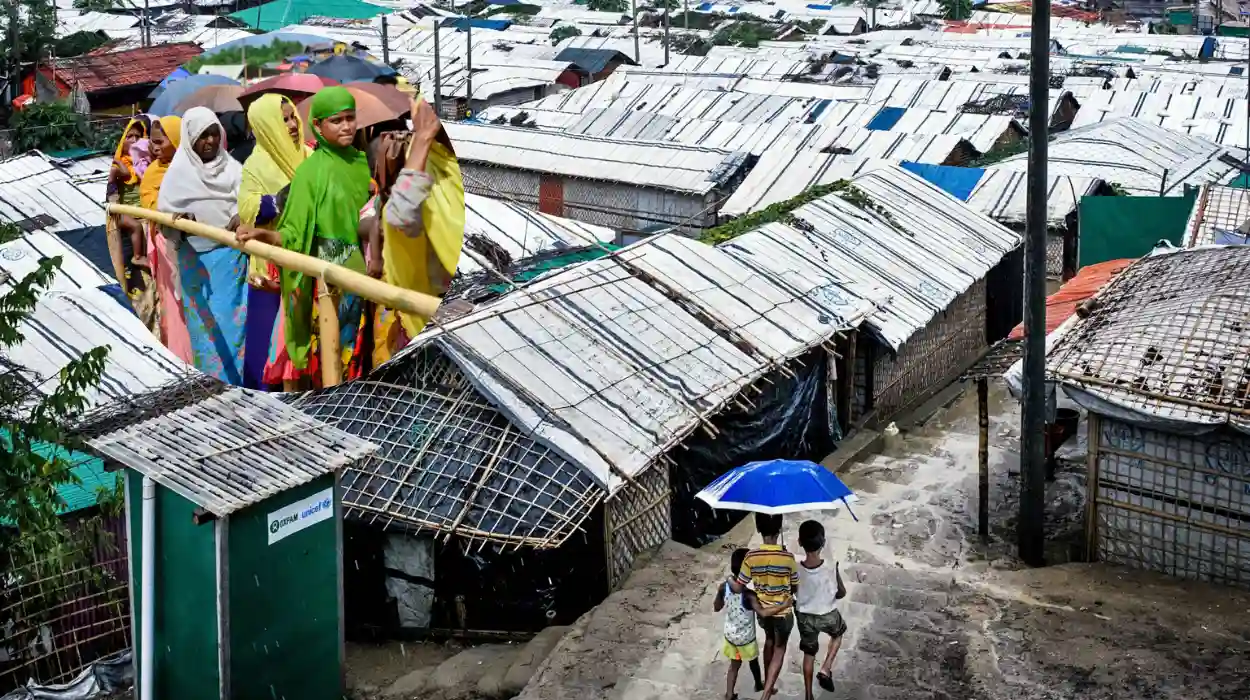
Sitting in a café in the bustling city of London might sound like a perfect night out for most Londoners on the weekend. But for the people living in the world’s largest refugee camp in Cox’s Bazar, Bangladesh, life couldn’t be more different. It’s far from fancy — it’s frightening, uncertain, and deeply unjust.
Amid countless struggles, one issue that haunts every Rohingya family is human trafficking. Parents like Rehan’s live in constant fear of losing their children — sons, daughters, brothers, and sisters — to traffickers who prey on desperation.
You might not have heard much about this crisis, and that’s part of the problem. There’s barely any global media coverage about human trafficking among the Rohingya. It often feels like it doesn’t matter to the world — not because ordinary people don’t care, but because the media and politicians in wealthier nations rarely give it attention. Perhaps it’s not “newsworthy” enough. But that silence has consequences.
Let’s rewind a little. The Rohingya were first persecuted and driven out of their homeland by the Myanmar military. Many fled unimaginable violence — massacres, villages burned, families torn apart — and sought refuge in Bangladesh. The Bangladeshi government deserves credit for sheltering them. But life in the camps soon brought new dangers.
Now, organized human trafficking networks operate within these refugee camps. These networks target vulnerable youth, promising them a way out — a chance to work in Malaysia, Indonesia, or Thailand, to earn money for their families and live with dignity. For many young Rohingya, these false promises feel like the only hope left. They don’t leave because they’ve given up; they leave because they want to help their families survive.
From my conversations with field reporters working on the ground, I learned that investigating these trafficking rings is extremely dangerous. The traffickers are well-organized, often working under the radar with the help of local middlemen who identify and lure potential victims.
Here’s how it works: once these young men and women are convinced, they’re taken to hidden locations, sometimes across the border into Myanmar where they made them stay for a while before they smuggle them — by road or by sea – into neighbouring countries like Malaysia, Thailand and Indonesia . The traffickers then demand ransom from their families. If the families can’t pay, the victims are tortured, and horrifying videos are sent back to pressure their loved ones.
It’s a heartbreaking cycle — one that repeats itself every day, largely unnoticed by the world.
From our limited field observations, it seemed that some of these trafficking groups may be operating with the tacit tolerance — or at least the inattention — of certain armed actors in the region. In some reported cases, this includes elements of the Myanmar army and the Arakan Army.
However, due to the total information blackout in Rakhine State, it is nearly impossible to verify these claims on the ground with full certainty. This blackout has made it extremely difficult for journalists and humanitarian monitors to confirm who controls specific territories or how these networks function within them.
We at Rohingya Return continues to investigate these crimes to draw the attention of politicians, the media, and the international community. This issue demands urgent action — not just sympathy.
With a heavy heart, I end this piece in hope — hope that one day, these trafficking networks will be dismantled, their perpetrators brought to justice, and the Rohingya people will finally see the sunrise over their homeland once again. A homeland where they can live freely, with dignity and peace — where they truly belong.